


Docs navigation
Input Stream
Input Stream is the entry point into Streamrun from your broadcasting software or device. Stream in from OBS, Streamlabs, Moblin, IRL Pro, action cameras, or any RTMP/SRT/SRTLA-capable source. Once connected, your input is ready to be processed, switched, or sent to multiple destinations.
Settings
Input type
Horizontal
Standard horizontal video via RTMP, SRT, or SRTLA.
Vertical
Vertical video (portrait orientation) via RTMP, SRT, or SRTLA.
Dual HD
For Dual Format Streaming. Stream horizontal and vertical orientations simultaneously on a single extra-wide canvas. Supports RTMP, SRT, and SRTLA. Only AVC (H.264) codec is supported.
RTMP/SRT Pull
Fetch a live stream from an external RTMP or SRT source rather than receiving a push from your device.
Shared with you
Inputs another Streamrun account has shared with you, listed by account and configuration. The stream arrives on their ingest, so this element has no stream key of its own and its type follows the source. See Shared inputs.
Stream URL & Key
Copy the Stream URL and Stream Key into your broadcasting software (OBS, IRL Pro, Moblin, etc.). Select the protocol that best fits your use case.
RTMP
Supports AVC, HEVC, and AV1 codecs. Widely supported and works well on stable connections.
SRT
Supports AVC and HEVC. Better than RTMP for mobile and unstable networks — handles packet loss well. Not all software supports SRT.
SRTLA
Supports AVC and HEVC. Enables network bonding over multiple connections (Wi-Fi + mobile + satellite). Best choice for very unstable networks. Adds a few seconds of latency. Currently in beta. Maximum accepted latency: 4000 ms.
ingest.streamrun.io routes automatically to the nearest ingest server over IPv4.For IPv6, use
ingest-ipv6.streamrun.io.No-signal image
Set an image to display when the input is offline. Upload via File Manager or select from the dropdown.
Horizontal: 1920×1080 PNG
Vertical: 1080×1920 PNG
Dual HD 2640: 2640×1280 PNG
Advanced settings
Input latency
How long Streamrun waits for incoming packets. Increase if the video has low FPS, stutters, or audio is out of sync. Lower = smoother interaction but needs a stable connection. Higher = more tolerant of unstable networks.
Audio gain
Amplification of the input audio signal in percent. 100 = no change, 50 = half volume, 200 = double volume.
RTMP/SRT Pull
Pull mode fetches a live stream from an external RTMP or SRT URL instead of receiving a push from your device. Streamrun connects to the URL and ingests the content into your configuration. If the connection fails, it retries automatically. Useful for rebroadcasting existing streams or adding external sources to a live production.
URL
The RTMP or SRT address to pull from.
Retry indefinitely
Keep retrying even after repeated failures. The input will not enter an error state, so monitor the connection manually.
Start pull automatically
Begin pulling as soon as the configuration starts in Preview or Running mode.
SRT latency and reliability
SRT is more reliable than RTMP on unstable networks and long-distance connections. The SRT latency value controls how tolerant the stream is of poor network conditions. Higher latency = more reliable, at the cost of increased interaction delay. The recommended value is 3–4× the round-trip time to the ingest server, which you can measure with:
ping ingest.streamrun.io
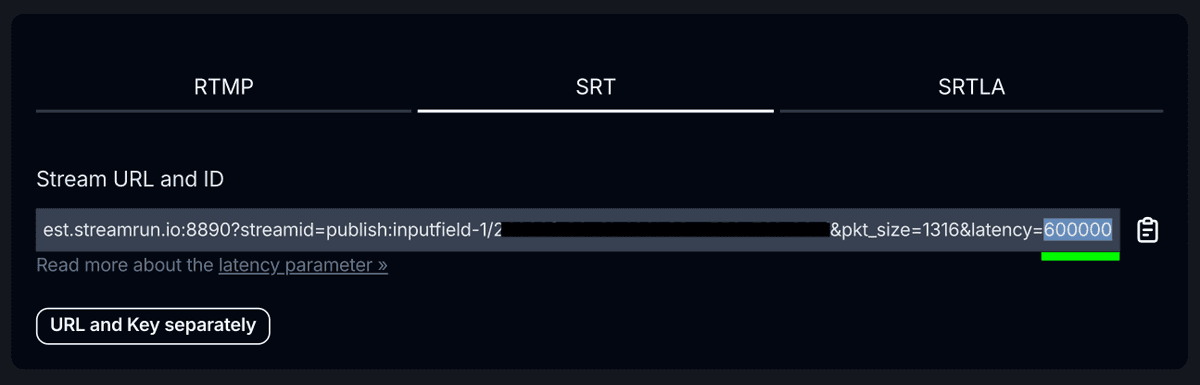
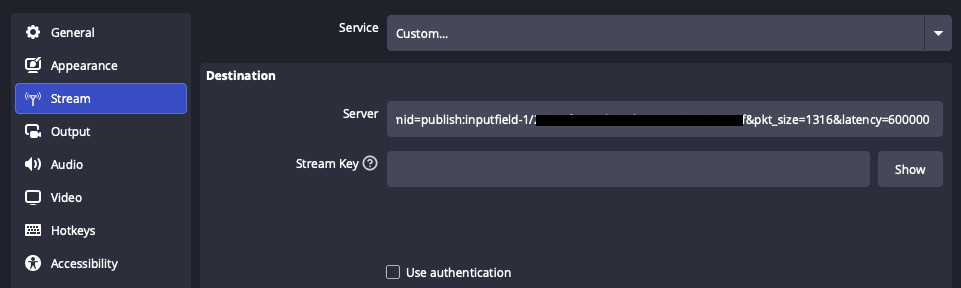
In OBS, the latency parameter must be included in the Stream URL rather than set in OBS itself. Select the SRT tab in the Stream URL dialog and click Show combined URL. The latency value appears at the end in microseconds (default 500000 = 500 ms). Paste this full URL into OBS's Server field and leave the Stream Key field empty.
Warnings and errors
Format mismatch
The incoming video does not match the selected input type. For example, the stream is horizontal but Vertical or Dual HD is selected. Update your broadcasting software or change the input type.
Unsupported codec
Dual HD supports only H.264. Change the codec in your broadcasting software.
RTMP/SRT Pull failed
The URL is invalid or the server denied the connection. Check the URL or contact your server provider.
Broadcasting guidelines
Streamrun supports a wide variety of resolutions, frame rates, codecs, and protocols. In most cases your existing streaming setup will work without changes.
Resolution
Up to Full HD (1920×1080)
Dual HD: 2640×1280 (horizontal + vertical)
Up to 4K with GPU acceleration add-on
Frame rate
Up to 60 fps
Video codec
AVC (H.264), HEVC (H.265), AV1
Dual HD supports AVC (H.264) only
Video bitrate
Max 25 Mbps
Recommended: max 70% of upload bandwidth
Min 2 Mbps
Keyframe interval
2 seconds
Codec settings
Color space: Rec. 709
B-frames: Off
Audio
AAC or OPUS codecs, 160 kbps recommended, 48 kHz
Two audio tracks supported (Twitch VOD track)
Protocols
RTMP (AVC / HEVC / AV1)
SRT (AVC / HEVC)
SRTLA (AVC / HEVC, beta)
Related
Output Stream
Configure where your stream is sent: Twitch, YouTube, Kick, or any RTMP endpoint.
Failover
Monitor input health and switch to a backup when the primary source drops.
IRL Streaming
Protocol recommendations, apps, and bitrate guidelines for mobile streaming.
Shared inputs
Share your ingest with another account, or use an input someone has shared with you, in the editor or on Streamrun Go.
 Join Streamrun Discord